




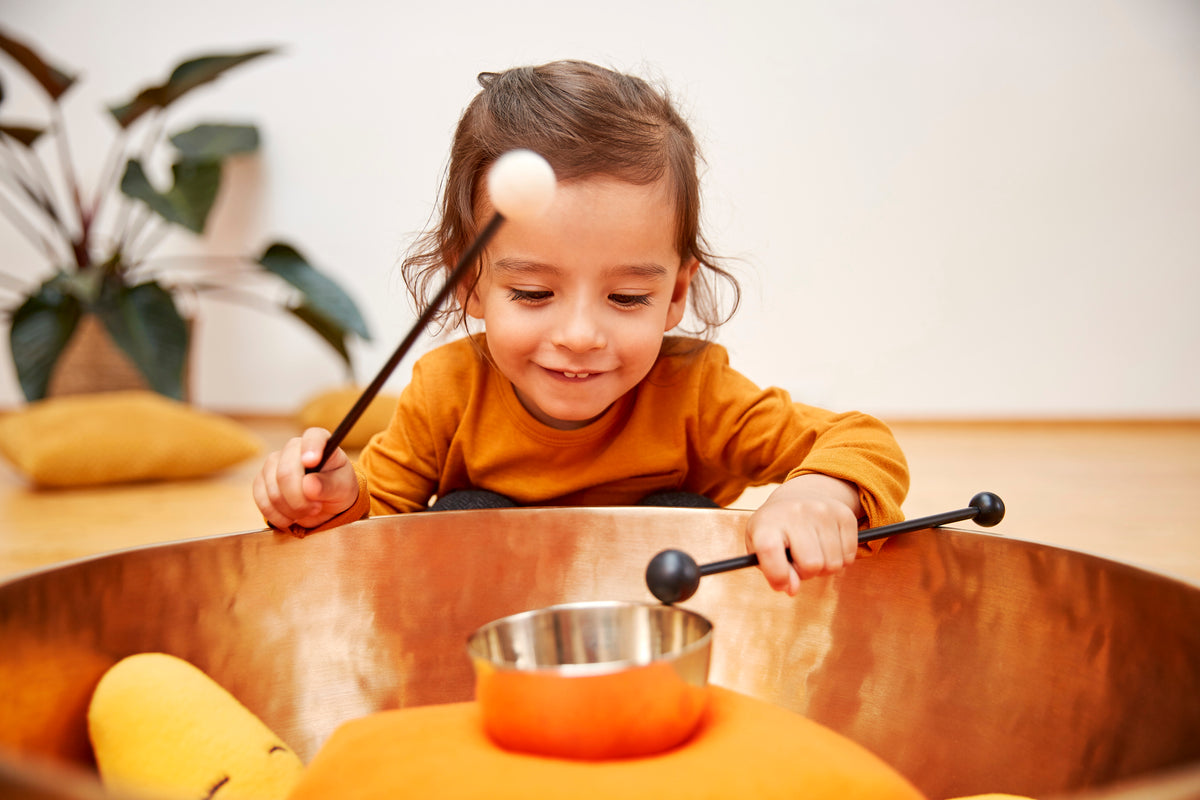
Children, too, are drawn to harmonious sounds. The sound and gentle vibration of singing bowls can be used in many different ways to promote perception, relaxation, concentration and social skills. That is why singing bowls and forms of sound therapy for children can be found today in many families, kindergartens and schools, in children's yoga and in occupational therapy practices.
The key points in brief
- Among other things, sound therapy for children aims to promote relaxation, concentration and attention.
- Children get to know singing bowls best through play. Singing bowls offer a lot of potential for this.
- Just as for adults, there are also singing bowl massages for children.
- In an educational context, singing bowl games with children can take place in a wide variety of ways.
What is the aim of singing bowl therapy for children?
Peter Hess, the founder of sound massage with singing bowls, developed the further training system "KliK® – Klingende Kommunikation" (sounding communication) together with his wife Emily Hess. With it, children learn how to relax. In singing bowl therapy for children, sensory and body awareness are trained, attention and concentration are promoted and mindfulness is practiced. This gives children important resources that enable them to meet the many demands of our fast-paced times, to stay physically and mentally healthy and to preserve their joy of life and creativity.
Sound therapy for children can pursue a wide range of goals. For example, promoting:
- Relaxation
- Concentration
- Attention
- Motivation
- Imagination and creativity
- Sensory and body awareness
- Awareness of one's own needs and those of others
- Expression of feelings
- Self-confidence and joy of life

How can I introduce children to singing bowls?
Children often perceive singing bowls as something special and precious, especially when adults present them accordingly. One way to introduce a singing bowl to children, for example, is to hide it under a cloth in a special place. First, the children may reach under the cloth with their eyes closed and guess what they can feel there and what you can do with it. Once the secret has been revealed, you try together to make the singing bowl sound.
Singing, nudging or filling
Children are often wonderfully relaxed and open-minded when handling singing bowls. The instrument can be made to sound in many ways and not only struck with a mallet in the usual way. Children can also sing into singing bowls, and the singing bowl sings along; you can gently nudge it with your fingers, and it sighs very softly; you can fill it with little balls that swish back and forth like the waves of the sea. And the great thing about it: it always sounds different. Sometimes the sounds are low and long-lasting, sometimes they are high and only ring very briefly.
"Children are our future. If we meet them with mindfulness and appreciation and give them opportunities to develop joyfully and freely, the foundation for a peaceful future is laid."
Peter Hess
Using it on the body, standing in it or filling it with water
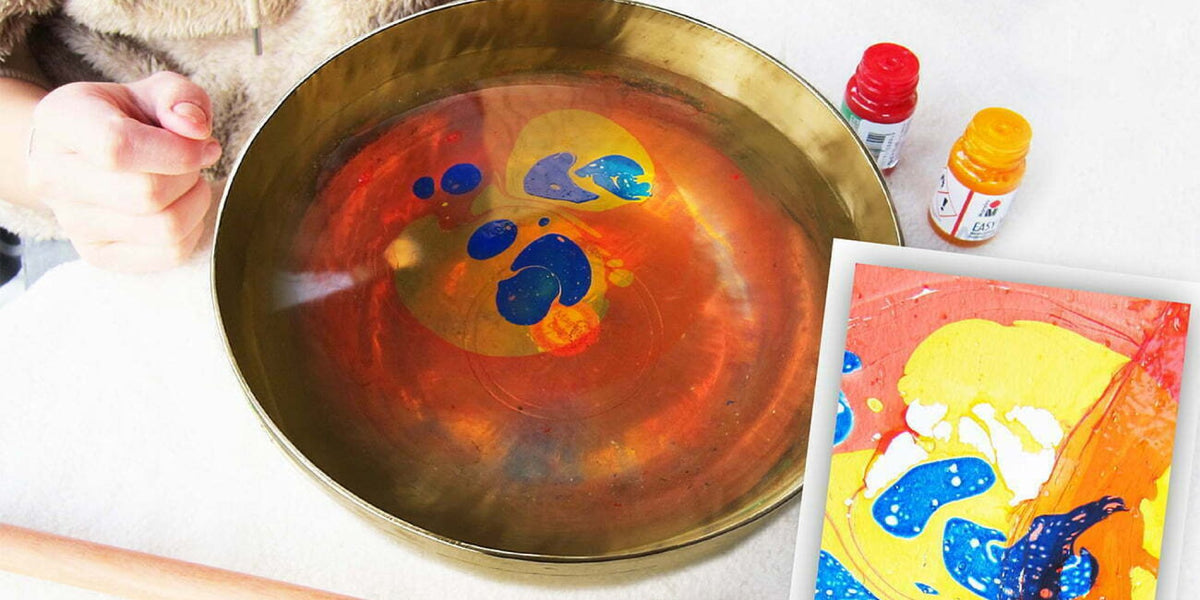
Children can also place a singing bowl on their belly or another part of the body, and if the singing bowl is big enough, they can even stand in it. When it is then struck, it tingles. Anyone who is quiet and listens carefully will notice how long a singing bowl can ring. It is also fun to fill the singing bowl with water and strike it firmly: this creates a real "sound fountain".
Experiments with fingers and mallets
What does it sound like when you nudge the singing bowl with the heel of your hand or when your fingernails dance across it? What is it like when you tap it with a felt mallet or a friction mallet or a rubber mallet, or swirl grains of sand or lentils back and forth inside it? There are no limits to the imagination here, so try out whatever comes to mind for you and the children. Everything is allowed, except pointed or hard objects that could damage the surface. After a while, let the singing bowl ring properly for the first time and ask the children to listen to the sound, not only with their ears, but with their whole body.

Are there singing bowl massages for children?
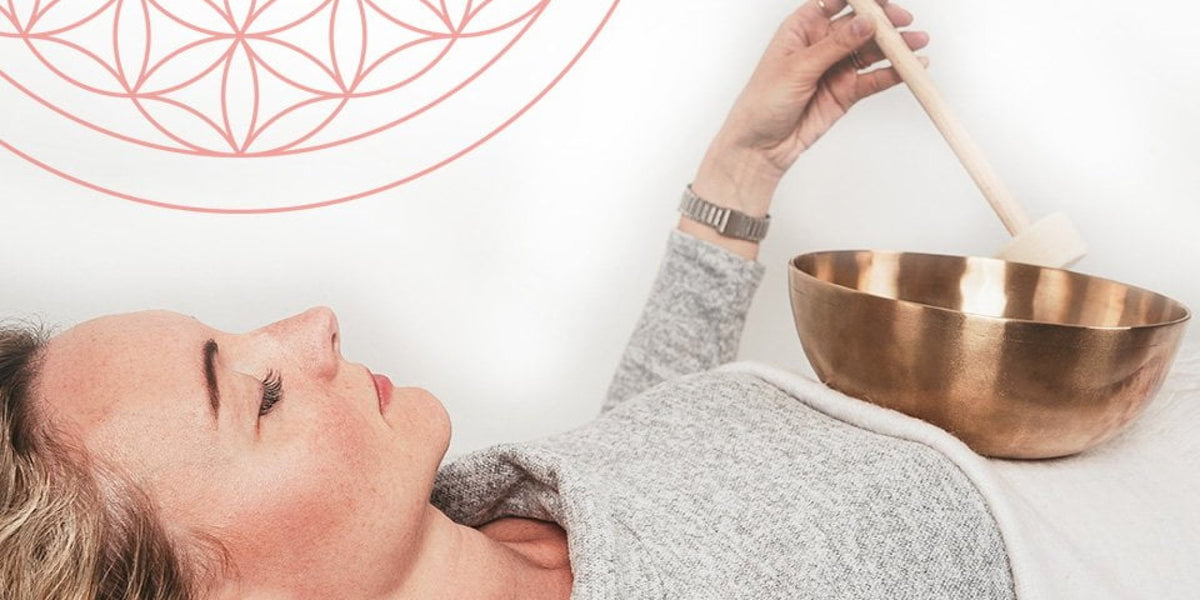
Yes. As in a regular sound massage, Therapy Singing Bowls are positioned on or around the body according to a specific system and gently struck during a singing bowl massage for children. Adults and children alike usually enjoy the fine tingling of the sound vibration and the soft fading of the harmonious sounds from the very first moment of a sound massage, which quickly leads to relaxation. Feelings of contentment, serenity and inner calm often arise.
What happens during a singing bowl massage for children?
During a singing bowl massage for children, the body is loosened by the sounds and the mind comes to rest, giving the soul room to unfold. The vibrations coming from the sounding and therefore vibrating singing bowls gradually spread through the skin, tissue, organs, body fluids and body cavities throughout the whole body. Our body, which consists of about 70 percent fluid, reacts sensitively to this fine stimulation. The sounds literally set it in motion, into flow. The fine vibration impulses very gently loosen muscular tension and adhesions in the fascial tissue and stimulate blood circulation and lymph flow.
Many people describe their experience during a sound massage as "a kind of very fine cell massage" that has a soothing effect deep into the body. For children, a sound massage can also feel like "a thousand sunbeams tingling in your tummy". In general, the following effects can be summarized.
Sound massage:
- Is a holistic method that addresses body, soul and mind
- Brings about deep relaxation
- Strengthens a person's basic trust
- Makes it easier to "let go" of worries, fears and doubts
- Contributes to health promotion: harmonization, regeneration and vitalization
- Supports and improves body awareness and self-perception
- Contributes to activating self-healing powers
- Enables access to and use of one's own resources
- Strengthens self-confidence, creativity, productivity and motivation
How long does a sound massage for children take?
A classic sound massage, including a preliminary talk and a rest afterward, takes about an hour. For working with children, various short sound massage offerings have been designed, depending on the age and personality of the child. Such sound massages for children are taught, for example, in the seminar "Sound massage with children: rediscovering the touch of all senses with children". The seminar builds on the training seminar "Sound Massage I: strengthening your own center" and teaches many possible variations of the classic basic sound massage especially for children. But of course children or teenagers can also give each other a small sound massage, or give one to their parents, which fills the little ones in particular with pride.
Many adults are amazed again and again at the sensitivity and mindfulness children show when giving a sound massage. Here, too, every experience is individual and can vary greatly from child to child.
Sound and imagery journeys with children
Children love sounds, and children love imagery journeys and stories, so what could be more natural than combining these two elements into sounding imagery journeys? Children usually reach a state of deep relaxation much faster than adults and at the same time follow the text very consciously. They often experience and live through the imaginative stories fully in the moment.
The sounds not only promote relaxation and strengthen attention, but also have a positive effect on concentration, memory and stamina. Selected imagery journeys can help children process inner tension, fears and experiences better and thus become a valuable resource for coping with life and building self-confidence.
"Imagination is more important than knowledge, for knowledge is limited. Imagination, however, encompasses the whole world."
Albert Einstein

Singing bowl games with children in an educational context
The many singing bowl games with children, sound exercises and sound settings can be ideally integrated into educational plans and curricula. They enrich the respective educational concepts and, as a nonverbal medium of communication and expression, help overcome language or cultural barriers in a playful way. Accordingly, they have also proven themselves as a complementary offering in inclusive facilities. Educators, teachers and parents appreciate not only the soothing effect on children and the general atmosphere, but also the fact that they themselves benefit from the sounds. Singing bowl games with children also become valuable recovery phases for them in an often stressful and noisy everyday life.
"In order for the enormous potential of possible connections in the brain to be stabilized as well as possible and for the talents inherent in our children to unfold, we must give them the opportunity to play for as long as possible."
Gerald Hüther
Sound-filled breaks in kindergarten
Children are often exposed to many stimuli that they cannot always filter or process adequately. In kindergarten, a relatively high noise level is part of everyday life. Some children cope with it better, others less so. Large groups of up to 25 children are a challenge, especially for the little ones. Educators, who face these stressors themselves every day, know all about it. Here, small sound breaks that lead back to calm again and again, focus attention and bring everyone involved into contact with themselves are particularly beneficial.
Comprehensive information and practical tips are offered by the intensive training to become a KliK® expert/practitioner (Klingende Kommunikation mit Kindern, sounding communication with children), which is aimed primarily at educational or therapeutic professionals.
Sound as support in everyday school life
The drive to learn and grow is inherent in all of us from the very beginning. Preserving the natural joy of learning is not always easy, because social influences and ideas of performance affect the learning process from an early age. A lack of concentration, high expectations and pressure to perform affect students, parents and teachers and quickly lead to dissatisfaction, tension and stress. KliK® aims to create a counterbalance here that offers relaxation, supports the joy of learning and helps strengthen concentration and stamina. It is always also about the personal development of children and young people, about discovering and cultivating resources that can support them in the long term on their path through life.
Singing bowl games with children and other sound offerings can be used not only in lessons, but also in study groups, in after-school care, in school social work or by school psychologists.
Whether in elementary school or in the upper grades, experience shows that the sound methods are a meaningful addition to the teaching process. They can be used in a targeted way in different situations and with different goals, for example:
- Using singing bowls for motivation to learn and better learning
- Learning with all the senses
- Sound rituals and sound innovation (at the start of lessons, during lessons, during breaks, before tests or exams, at the end of the day)
- Promoting concentration
- Supporting integration and inclusion with sound
- Strengthening social learning and mindfulness
- Accompanying how conflict situations are handled